
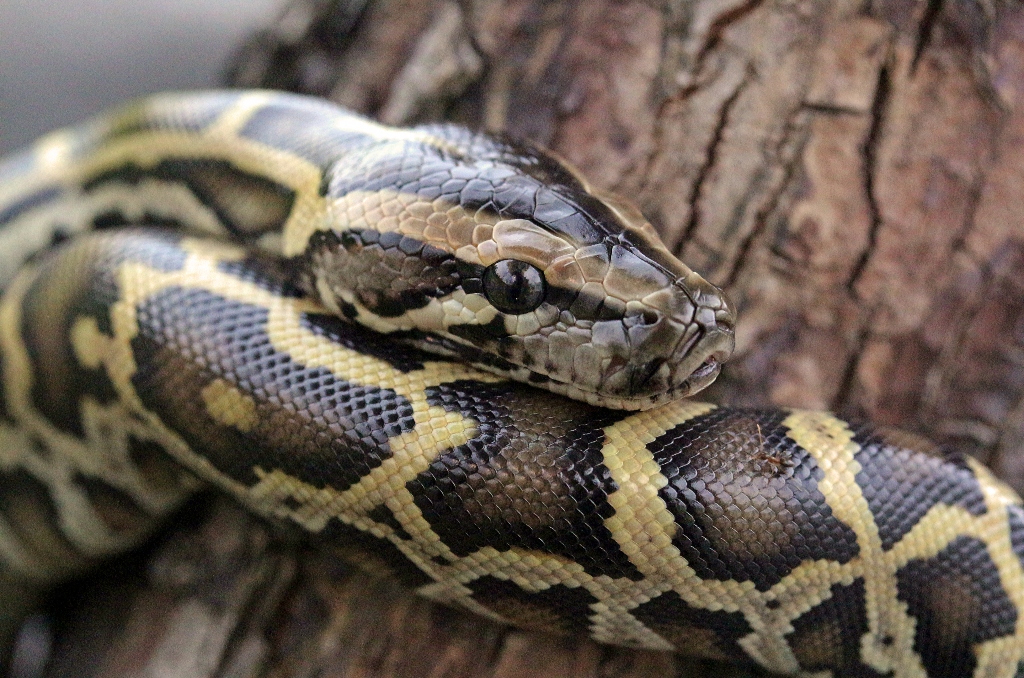
Burmese Pythons – Photo Credit: Vince Adam/Shutterstock.com
From holding public hunting competitions and employing bounty hunters to equipping male “scout” snakes with tracking devices that can direct them to large, fertile females, Florida wildlife biologists are doing everything in their power to remove invasive Burmese pythons.
In order to combat the devastating snakes, they have now developed a novel new weapon: robotic bunnies.
According to Kimberly Miller of the Palm Beach Post, researchers at the University of Florida are putting the so-called “robo-bunnies” all around South Florida in an attempt to entice Burmese pythons to come out of hiding so they can be put down. Biologists can avoid spending time looking for the snakes in the swamp by attracting the pythons to the rabbit-like creatures.
Burmese pythons enjoy eating marsh rabbits (Sylvilagus palustris), and the animatronic rabbits are equipped with motors and internal heaters that mimic their body temperatures and activities.
The Florida Fish and Wildlife Conservation Commission has already funded similar research, and the robotic rabbit experiment is being funded by the South Florida Water Management District.
Robert McCleery, a wildlife ecologist at the University of Florida who is in charge of the rabbit study, tells the Palm Beach Post, “Our partners have allowed us to trial these things that may sound a little crazy.” After ten years of working in the Everglades, you grow weary of recording the issue. You wish to deal with it.
Researchers had previously tried attracting the invasive serpents in Everglades National Park by keeping live rabbits in enclosures. Although the live bunnies were successful in attracting the snakes—roughly one each week—managing and caring for the tiny creatures required a lot of work. Scientists questioned if robotic bunnies could perform the task equally well.
To find out, McCleery and his coworker Chris Dutton collected forty toy bunnies and swapped out their stuffing with solar-powered electrical components. In order for the bunnies to survive the rain and humidity in South Florida, they were additionally waterproofed. Scientists conducted a preliminary research earlier this month to determine if the bunnies could trick the snakes by placing them at different, secret sites.
Mike Kirkland, lead invasive animal biologist for the South Florida Water Management District, tells Bridget Bruchalski of WINK-TV that “it would be a success if we can see a statistically significant number of pythons that are coming to investigate these robotic rabbits and the pens, because right now, pythons do a great job of staying hidden.”
Tiny cameras that have been configured to detect movement accompany the remotely operated decoys. The camera notifies researchers when a python (or other snake) slithers by, causing them to watch the video feed to determine the type of snake that is approaching.
“If that Python is found, it gets in touch with someone like me, who is available around-the-clock, and I can send one of our numerous contractors to go get it,” Kirkland told WINK-TV.
The scientists intend to conduct a second round of testing with actual rabbit odors added to the mechanical creatures if the first attempt is unsuccessful in luring pythons.
McCleery tells the Palm Beach Post, “We want to capture all of the processes that an actual rabbit would give off.”
Originally from Southeast Asia, Burmese pythons started coming to the US in the 1990s and early 2000s as part of the exotic pet trade. These pet snakes eventually escaped or were put back into the wild, where they swiftly acclimated to Florida life.
The Everglades’ rabbits, foxes, opossums, and raccoons have had to pay the price as a result of the snakes’ proliferation due to a lack of natural predators to control them. According to a 2015 research, 77 percent of rabbit deaths in Everglades National Park were caused by Burmese pythons.
According to experts, completely eliminating Burmese pythons from Florida is unlikely to be feasible. However, biologists and conservationists are working to reduce the number in the interim.
For example, the yearly Florida Python Challenge offers the public a chance to win $10,000 by killing and removing as many Burmese pythons as they can in ten days. The event this year concluded on July 20.
As long as they have the landowner’s consent, hunters on private property are always permitted to humanely put the snakes down without a permit. On certain public properties under the Florida Fish and Wildlife Conservation Commission’s management, they can also humanely kill Burmese pythons. The Florida Fish and Wildlife Conservation Commission’s exotic species hotline is urged to be called by anyone who spots a Burmese python.
The Palm Beach Post reports that since 2019, the Florida Fish and Wildlife Conservation Commission and the South Florida Water Management District have also sent out python bounty hunters, who have taken out almost 16,000 of the snakes.
Stories that matter are our priority. At Florida Insider, we make sure that the information we provide our readers is accurate, easy-to-read, and informative. Whether you are interested in business, education, government, history, sports, real estate, nature or travel: we have something for everyone. Follow along for the best stories in the Sunshine State.

Born and raised in South Florida, Krystal is a recent graduate from the University of Miami with professional writing experience at the collegiate and national news outlet levels. She’s a foodie who loves all things travel, the beach, & visiting new places throughout Florida.